| After
the Allied landing in Normandy in
June 1944, the western Allies rapidly
advanced in the direction of the
Dutch border. Tuesday September
5 is known as Dolle dinsdag (“mad
Tuesday”)—the Dutch
began celebrating, believing they
were close to liberation. In September,
the Allied launched Operation Market
Garden, an attempt to advance from
the Dutch-Belgian border across
the rivers Meuse, Waal and Rhine
into the north of the Netherlands
and Germany. However, the Allied
forces did not reach this objective
because they could not capture the
Rhine bridge at the Battle of Arnhem.
During Market Garden, substantial
regions to the south, including
Nijmegen and much of North Brabant,
were liberated. Much of the northern
Netherlands remained in German hands
until the Rhine crossings in late
March 1945. Parts
of the southern Netherlands were
not liberated by Operation Market
Garden, which had established a
narrow salient between Eindhoven
and Nijmegen.
In the east of North Brabant and
in Limburg, British and American
forces in Operation Aintree managed
to defeat the remaining German forces
west of the Meuse between late September
and early December 1944, destroying
the German bridgehead between the
Meuse and the Peel marshes. During
this offensive the only tank battle
ever fought on Dutch soil took place
at Overloon.At the same time, the
Allies also advanced into the province
of Zeeland. At the start of October
1944, the Germans still occupied
Walcheren and dominated the Scheldt
estuary and its approaches to the
port of Antwerp. The crushing need
for a large supply port forced the
Battle of the Scheldt in which First
Canadian Army fought on both sides
of the estuary during the month
to clear the waterways. Large battles
were fought to clear the Breskens
Pocket, Woensdrecht and the Zuid-Beveland
Peninsula of German forces, primarily
units of the Wehrmacht as well as
German paratroopers of Battle Group
Chill.
By 31 October, resistance south
of the Scheldt had collapsed, and
the Canadian 2nd Infantry Division,
British 52nd (Lowland) Division
and 4th Special Service Brigade
all made attacks on Walcheren Island.
Strong German defenses made a landing
very difficult, and the Allies responded
by bombing the dykes of Walcheren
at Westkapelle, Vlissingen and Veere
to flood the island. Though the
Allies had warned residents with
pamphlets, 180 inhabitants of Westkappelle
died. The coastal guns on Walcheren
were silenced in the opening days
of November and the Scheldt battle
declared over. No German forces
remained intact along the 64-mile
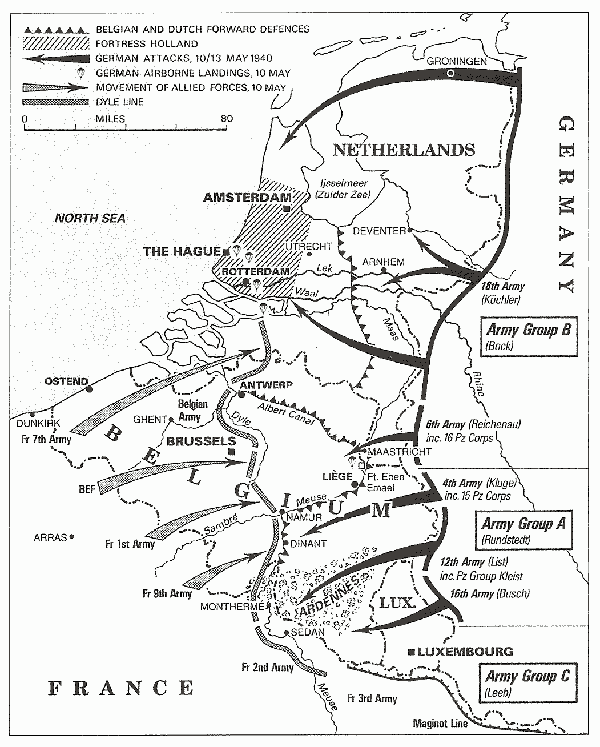
path to Antwerp.The Dutch government
had not wanted to use the old water
line when the Germans had invaded
in 1940.
It was still possible to create
an island out of Holland by destroying
dykes and flooding the polders,
but this island contained the main
cities. The Dutch government had
decided then that there were too
many people to keep alive to justify
the flooding. However, Hitler ordered
that Festung Holland be held at
any price. The winter of 1944–1945
was very severe, and this led to
hunger journeys and starvation (about
30,000 deaths), exhaustion, cold
and disease.
This winter is known as the Hongerwinter
(“hunger winter”), or
Dutch famine of 1944. The food situation
was aggravated by a general railway
strike ordered by the Dutch government-in-exile
in expectation of a general German
collapse near the end of 1944.On
the island of Texel, nearly 800
Georgians, part of the German army,
rebelled on April 5, 1945. Their
rebellion was crushed by the German
army after two weeks of battle.
565 Georgians, 120 inhabitants of
Texel, and 800 Germans died. The
228 surviving Georgians were forcibly
repatriated to the Soviet Union
when the war ended.After crossing
the Rhine at Wesel and Rees, Canadian
forces entered the Netherlands from
the east, liberating the eastern
and northern provinces.
The western provinces, where the
situation was worst, however, had
to wait until the surrender of German
forces in the Netherlands was negotiated
on the eve of May 5, 1945 (three
days before the general capitulation
of Germany), in the De Wereld Hotel
in Wageningen. Previously the Swedish
Red Cross had been allowed to provide
relief efforts, the most memorable
ones employing Allied bombers dropping
food over the German-occupied territories
in Operation Manna.
Casualties
By the end of the war 205,900 Dutch
men and women had died. The Netherlands
had the highest per capita death
rate of all Nazi-occupied countries
in Western Europe, 2.36%. Another
30,000 died in the Dutch East Indies,
either while fighting the Japanese
or in camps as Japanese POWs. Dutch
civilians were held in those camps
as well.
Ardennes-Alsace
Campaign
16 December 1944–25
January 1945
In August 1944,
while his armies were being destroyed
in Normandy, Hitler secretly put
in motion actions to build a large
reserve force, forbidding its use
to bolster Germany’s beleaguered
defenses. To provide the needed
manpower, he trimmed existing military
forces and conscripted youths, the
unfit, and old men previously untouched
for military service during World
War II.In September Hitler named
the port of Antwerp, Belgium, as
the objective. Selecting the Eifel
region as a staging area, Hitler
intended to mass twenty-five divisions
for an attack through the thinly
held Ardennes Forest area of southern
Belgium and Luxembourg. Once the
Meuse River was reached and crossed,
these forces would swing northwest
some 60 miles to envelop the port
of Antwerp. The maneuver was designed
to sever the already stretched Allied
supply lines in the north and to
encircle and destroy a third of
the Allies’ ground forces.
If successful, Hitler believed that
the offensive could smash the Allied
coalition, or at least greatly cripple
its ground combat capabilities,
leaving him free to focus on the
Russians at his back door.
Central
Europe Campaign
22 March–11 May 1945
By the beginning
of the Central Europe Campaign of
World War II, Allied victory in
Europe was inevitable. Having gambled
his future ability to defend Germany
on the Ardennes offensive and lost,
Hitler had no real strength left
to stop the powerful Allied armies.
Yet Hitler forced the Allies to
fight, often bitterly, for final
victory. Even when the hopelessness
of the German situation became obvious
to his most loyal subordinates,
Hitler refused to admit defeat.
Only when Soviet artillery was falling
around his Berlin headquarters bunker
did the German Fuehrer begin to
perceive the final outcome of his
megalomaniacal crusade.
Normandy
Campaign
6 June–24 July 1944
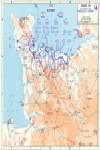
A great invasion
force stood off the Normandy coast
of France as dawn broke on 6 June
1944: 9 battleships, 23 cruisers,
104 destroyers, and 71 large landing
craft of various descriptions as
well as troop transports, mine sweepers,
and merchantmen—in all, nearly
5,000 ships of every type, the largest
armada ever assembled. The naval
bombardment that began at 0550 that
morning detonated large minefields
along the shoreline and destroyed
a number of the enemy’s defensive
positions. To one correspondent,
reporting from the deck of the cruiser
HMS Hillary, it sounded like “the
rhythmic beating of a gigantic drum”
all along the coast. In the hours
following the bombardment, more
than 100,000 fighting men swept
ashore to begin one of the epic
assaults of history, a “mighty
endeavor,” as President Franklin
D. Roosevelt described it to the
American people, “to preserve.
. . our civilization and to set
free a suffering humanity.”
Northern
France Campaign
25 July–14
September 1944
As July 1944 entered
its final week, Allied forces in
Normandy faced, at least on the
surface, a most discouraging situation.
In the east, near Caen, the British
and Canadians were making little
progress against fierce German resistance.
In the west, American troops were
bogged down in the Norman hedgerows.
These massive, square walls of earth,
five feet high and topped by hedges,
had been used by local farmers over
the centuries to divide their fields
and protect their crops and cattle
from strong ocean winds. The Germans
had turned these embankments into
fortresses, canalizing the American
advance into narrow channels, which
were easily covered by antitank
weapons and machine guns. The stubborn
defenders were also aided by some
of the worst weather seen in Normandy
since the turn of the century, as
incessant downpours turned country
lanes into rivers of mud. By 25
July, the size of the Allied beachhead
had not even come close to the dimensions
that pre–D-day planners had
anticipated, and the slow progress
revived fears in the Allied camp
of a return to the static warfare
of World War I. Few would have believed
that, in the space of a month and
a half, Allied armies would stand
triumphant at the German border.
Rhineland
Campaign
15 September 1944–21 March
1945
The Rhineland Campaign,
although costly for the Allies,
had clearly been ruinous for the
Germans. The Germans suffered some
300,000 casualties and lost vast
amounts of irreplaceable equipment.
Hitler, having demanded the defense
of all of the German homeland, enabled
the Allies to destroy the Wehrmacht
in the West between the Siegfried
Line and the Rhine River. Now, the
Third Reich lay virtually prostrate
before Eisenhower’s massed
armies.
The
Siegfried Line
The Siegfried Line
was a defence system stretching
more than 630 km (390 mi) with more
than 18,000 bunkers, tunnels and
tank traps. It went from Kleve on
the border with the Netherlands,
along the western border of the
old German Empire as far as the
town of Weil am Rhein on the border
to Switzerland. More with propaganda
in mind than for any strategic reason,
Adolf Hitler planned the line from
1936 and had it built between 1938
and 1940. This was after the Nazis
had broken the Treaty of Versailles
and the Locarno Treaties by remilitarizing
the Rhineland in 1936.
The Siegfried Line was a defence
system stretching more than 630
km (390 mi) with more than 18,000
bunkers, tunnels and tank traps.
It went from Kleve on the border
with the Netherlands, along the
western border of the old German
Empire as far as the town of Weil
am Rhein on the border to Switzerland.
More with propaganda in mind than
for any strategic reason, Adolf
Hitler planned the line from 1936
and had it built between 1938 and
1940. This was after the Nazis had
broken the Treaty of Versailles
and the Locarno Treaties by remilitarizing
the Rhineland in 1936.
The Siegfried Line was a defence
system stretching more than 630
km (390 mi) with more than 18,000
bunkers, tunnels and tank traps.
It went from Kleve on the border
with the Netherlands, along the
western border of the old German
Empire as far as the town of Weil
am Rhein on the border to Switzerland.
More with propaganda in mind than
for any strategic reason, Adolf
Hitler planned the line from 1936
and had it built between 1938 and
1940. This was after the Nazis had
broken the Treaty of Versailles
and the Locarno Treaties by remilitarizing
the Rhineland in 1936.
|