|
www.WorldWar2Files.com
Researching World War II World War II
Research CDs
|
|
1st
Infantry
Division
"Big Red One"
"The Fighting First"
|
|
4 VOLUMES
- 8 CDS
The
1st Division is a 4 Volume
8 CD Set.
Each Volume is 2 CDs and represents
a year.
$30 plus $2 postage each Volume.
Digital download $30
- Save
$2 postage.
PAYPAL
PAYMENT LINKS
VOLUME
1 |
|
Digital
download $30
- BUY |
| VOLUME
2 |
|
Digital
download $30
- BUY |
VOLUME
3 |
|
Digital
download $30
- BUY |
VOLUME
4 |
|
Digital
download $30
- BUY |
Digital
downloads are not
automatic. Orders
come in as emails
that get sent when
read.
Sales to Europe and
Asia digital download
only.
|
Click
Links to See Files List
There's
an approx. total of 304 pdf
files, 36 pdf maps and 2 videos.
This
grouping of information
is for the World War
2 Researcher or Family
Member. CDs are designed
to be easy to navigate
and find files. Files
consist of Monographs,
Division Reports,
Narratives, Battles,
Campaigns, Operations,
General Orders and
Published Histories,
etc.
A
monograph is a work
of writing or essay
or book on a specific
subject and may be
released in the manner
of a book or journal
article. Files copied
from books and the
National Archives
and are 'as is' and
may be incomplete
or unreadable in parts. |
|
-
Nomenclature - |
|
Ops
= Operations |
GO
= General Orders |
HQ
= Headquarters |
MR
= Morning Reports |
|
G3
= Operations Branch |
Co
= Company |
Bn
= Battalion |
FA
= Field Artillary |
ir
= Infantry |
id
= Infantry Division |
CMH
= Center for Military
History |
Dating:
4202-01 = 1 Feb 1942 |
VOL 1 - CD1
- 1941-1943 - Division,Regiments,Armies,Corps
- 378mb - 50 pdfs
VOL 1 - CD2
- 1941-1943 - GO,Battles.Ops,Campaigns,Embarkation
- 280mb - 63 pdfs
VOL 2 - CD1
- 1944 - Division,Regiments,GO
- 372mb - 49 pdfs
VOL 2 - CD2
- 1944 - Battles,Campaigns,Ops
- 581mb - 47 pdfs
VOL 3 - CD1
- 1944 - Medals,Citations,Maps,etc
- 266mb - 39 pdfs
VOL 3 - CD2
- 1944 - Video - 340mb - 2 videos
VOL 4 - CD1
- 1945 - Division,Regiments,Battles,Ops,GO
- 217mb - 13 pdfs
VOL 4 - CD2
- 1945-1946 - Armies,ArmyGroups,Corps,GO
- 502mb - 36 pdfs
|
|
1st Infantry Division
VOL
1 - CD1
1941-1943 - 378mb - 50pdfs
FILES: Division,Regiments,Armies,Corps
1st-id-EngineerCombatBattalion-Wiki-13pgs.pdf
1st-id-1st-EngCombatBn-Ops-1941-1945-168pgs.pdf
1st-id-GIStories-23pgs.pdf
1st-id-History-29pgs.pdf
1st-id-History-1939-1945-OspreyBook-51pgs.pdf
1st-id-History-BigRedOne-SpearheadBook-98pgs.pdf
1st-id-Wiki-42pgs.pdf
957th-FieldArtillery-Bn-UnitHistory-152pgs.pdf
957th-FieldArtillery-MonsIncident-3pgs.pdf
4202-01-1st-id-16th-ir-CoE-History-1feb-6may42-1pg.pdf
4208-08-1st-id-NorthAfrica-Sicily-8aug42-7aug43-24pgs.pdf
4209-17-1st-id-HQ-OrderOfBattle-Algeria-MAP-1pg.pdf
4210-10-1st-id-OpTorch-BoatPlan-1pg.pdf
4210-10-1st-id-OpTorch-Keypoints-1pg.pdf
4210-10-1st-id-OpTorch-PrisonerInterrogation-54pgs.pdf
4211-08-1st-id- HQ-UnitReport-Enc8-TorchOps-8-10nov42-9pgs.pdf
4211-08-1st-id-16th-ir-2ndBn-NorthAfricaInvasion-8-11Nov42-20pgs.pdf
4211-08-1st-id-18th-ir-2ndBn-AntiTank-StCloud-Algiers-22pgs.pdf
4211-08-1st-id-18th-ir-AntiTank-StCloud-Algeria-26pgs.pdf
4211-08-1st-id-26th-ir-AntiTank-2ndBn-Ops-ElAncor-Algeria-40pgs.pdf
4211-08-1st-id-26th-ir-CoG-Ops-Oran-31pgs.pdf
4211-17-1st-id-HQ-TorchOps-FieldOrders-12pgs.pdf
4211-24-1st-id-G3-Report-OpTorch-10pgs.pdf
4212-17-1st-id-26th-ir-CoL-NightRaid-MaknassyTunisia-28pgs.pdf
1943-1944-1st-id-16th-ir-HistoricalReports-1sep43-14jun44-8pgs.pdf
4303-17-1st-id-18th-ir-1stBn-Ops-ElGuettar-Tunisia-33pgs.pdf
4303-17-1st-id-18th-ir-3rdBn-Ops-ElGuettar-Tunisia-28pgs.pdf
4303-20-1st-id-Ops-ElGuettar-Tunisia-20-24mar43-25pgs.pdf
4303-20-1st-id-Ops-ElGuettar-Tunisia-20-30mar43-25pgs.pdf
4303-29-1st-id-16th-ir-CoF-Ops-ElGuettar-Tunisia-27pgs.pdf
4304-23-1st-id-Ops-Mateur-Tunisia-33pgs.pdf
4304-29-1st-id-16th-ir-1stBn-Mateur-Hill523-Tunisia-31pgs.pdf
4305-24-1st-id-LandingAssaultExercises-24May-23Jun43-82pgs.pdf
4307-06-1st-id-26th-ir-S1Journal-SicilyTranscript-123pgs.pdf
4307-28-1st-id-16th-ir-CoA-Ops-Nicosia-Sicily-29pgs.pdf
4301-01-2Corps-OperationsReport-Tunisia-1jan-15mar43-19-pgs.pdf
4302-10-2Corps-Orders-KasserinePass-5pgs.pdf
4302-10-2Corps-KasseringPass-OrderOfBattle-4pgs.pdf
4302-14-2Corps-BattleKasserinePass-28pgs.pdf
4303-15-2Corps-OperationsReport-Tunisia-29pgs.pdf
4303-15-2Corps-Tunisia-OpsReport-26pgs.pdf
4304-23-2Corps-Ops-CaptureOfBizerte-Tunisia-23apr-9may-40pgs.pdf
4304-23-2Corps-ToBizerteWithThe2Corps-23apr-13may43-102pgs.pdf
4005-01-3rd-Army-HQ-4Corps-Maneuvers-FinalReport-61pgs.pdf
4100-00-3rd-Army-Maneuvers-Report-2and3Corps-47pgs.pdf
4306-22-3rd-Army-Maneuvers-ObserversReport-22jun-5jul43-124pgs.pdf
4307-10-7th-Army-OpHusky-Patton-77pgs.pdf
4307-10-7th-Army-OpsReport-Sicily-10jul-17aug43-340pgs.pdf
4308-01-7th-Army-G2-Estimate-NortheasternSicily-18pgs.pdf
4308-01-7th-Army-HQ-G2-EstimateEnemySituation6-22pgs.pdf |
|
1st Infantry Division
VOL
1 - CD2
1941-1943 - 280mb - 63 pdfs
FILES: GO,Battles.Ops,Campaigns,Embarkation
AFRICA.PDF
4211-08-Algeria-FrenchMorocco-CMH-32pgs.pdf
4211-08-Algiers-Operation-8-11nov42-26pgs.pdf
4211-17-TunisiaCampaign-CMH-32pgs.pdf
4301-30-KasserinePass-CMH-vol.1-2-168pgs.pdf
4301-30-KasserinePass-CMH-vol1-1-187pgs.pdf
4302-14-BattleKasserinePass-28pgs.pdf
4304-23-BattleTunisia-23Apr-9May43-24pgs.pdf
4307-10-Operation-Husky-SicilyInvasion-38pgs.pdf
4307-31-BattleTroina-CMH-31Jul-6Aug43-20pgs.pdf
4307-31-BattleTroina-Wiki-31Jul-6Aug43-5pgs.pdf
4310-01-Algiers-EisenhowerAidDiary-8pgs.pdf
BattleKasserinePass-Wiki-16pgs.pdf
BattleTroina-Sicily1943-Wargamerabbit-24pgs.pdf
KasserinePass-Defeat-53pgs.pdf
KasserinePass-RommelsLastVictory-Osprey-97pgs.pdf
OperationHusky-MAPS-37pgs.pdf
OperationHusky-Study-114pgs.pdf
OperationHusky-Wiki-32pgs.pdf
OperationTorch-Battles.pdf
OperationTorch-Wiki-8pgs.pdf
SICILY.PDF
Sicily-InvasionReport-24pgs.pdf
TheFirstPhase-The2CorpsDrivesToMateur-16pgs.pdf
TheSecondPhase-AxisResistanceIsBroken.-9pgs.pdf
ToBizerteWithThe2Corps-CMH-102pgs.pdf
TunisianCampaign-Wiki-30pgs.pdf
4112-30-1st-id-Embarkation-Memo3-7pgs.pdf
4112-30-1st-id-Embarkation-Memo4-4pgs.pdf
4112-30-1st-id-Embarkation-Memo5-1pg.pdf
4112-30-1st-id-Embarkation-Memo7-1pg.pdf
4201-01-1st-id-Embarkation-Memo8-1pg.pdf
4201-02-1st-id-Embarkation-Memo10-5pgs.pdf
4201-07-1st-id-Embarkation-Memo14-6pgs.pdf
4202-02-1st-id-Embarkation-Memo12-6pgs.pdf
4202-07-1st-id-Embarkation-Memo13-3pgs.pdf
4202-07-1st-id-Embarkation-Memo15-8pgs.pdf
4211-10-1st-id-GeneralOrders-31-8nov-26dec42-28pgs.pdf
4301-04-1st
id-GeneralOrders-1to67-4jan-1dec43-273pgs.pdf
4305-02-1st-id-Artillery-GeneralOrders-3to9-2may-28dec43-7pgs.pdf
4307-01-1st-id-SpecialOrders-123-1pg.pdf
4303-15-2Corps-Operations-MAPS-Tunisia-5pgs.pdf
4304-23-2Corps-OpsCaptureBizerte-Tunisia-40pgs.pdf
|
1st Infantry Division
VOL
2 - CD1
1944 - 372mb - 49 pdfs
FILES: Division,Regiments,GO
4401-01-1st-id-16th-ir-HistoricalReports-1jan-14jun44-1pg.pdf
4401-28-1st-id-GeneralOrders-1to-105-28jan-12oct44-458pgs.pdf
4403-02-1st-id-Artillery-GeneralOrders-6to12-2mar-17nov44-14pgs.pdf
4403-02-1st-id-SpecialTroops-GeneralOrders-2to12-2mar-17nov44-2pgs.pdf
4406-05-1st-id-16th-ir-CoH-MorningReports-5jun-8dec44-5pgs.pdf
4406-06-1st-id-16th-ir-3rdBn-OmahaBeach-35pg.pdf
4406-06-1st-id-16th-ir-CoH-History-1944-45-20pgs.pdf
4406-06-1st-id-16th-ir-CoH-MorningReports-3pgs.pdf
4406-06-1st-id-16th-ir-Journal-5pgs.pdf
4406-06-1st-id-16th-ir-MeritoriousUnit-1pg.pdf
4406-06-1st-id-16th-ir-S3-InvasionSummary-24pgs.pdf
4406-06-1st-id-18th-ir-JournalEntries-5pgs.pdf
4406-06-1st-id-18th-ir-MedalofHonorRecepient-1pg.pdf
4406-06-1st-id-G3-Normandy-AfterActionReport-5pgs.pdf
4406-06-1st-id-G3-Ops-DDay-AfterActionReport-1pg.pdf
4406-06-1st-id-MP-Ops-OmahaBeach-24pgs.pdf
4406-06-1st-id-Ops-OmahaBeachheadLanding-35pgs.pdf
4406-07-1st-id-16th-ir-Journal-8pgs.pdf
4406-08-1st-id-26th-ir-CoL-Ops-Ste.Anne-France-33pgs.pdf
4406-09-1st-id-26th-ir-CoL-3rdBn-Ops-AgyFrance-33pgs.pdf
4406-12-1st-id-16th-ir-CoH-Statement-SgtHopes-1pg.pdf
4407-00-1st-id-HQ-QM-AfterActionReport-1pg.pdf
4407-01-1st-id-16th-ir-AfterActionReport-1-31Jul44-7pgs.pdf
4407-25-1st-id-Ops-St.Lo-Breakthrough-25Jul-1Aug44-37pgs.pdf
4408-14-1st-id-SpecialTroops-GeneralOrders-2-2pgs.pdf
4408-25-1st-id-MonsAachen-Ch.9-13pgs.pdf
4408-31-1st-id-CorrespondentsReport-MonsBelgium-9pgs.pdf
4409-01-1st-id-Ops-MonsBelgium-38pgs.pdf
4409-04-1st-id-18th-ir-2ndBn-Ops-Bruyere-Belgium-29pgs.pdf
4409-12-1st-id-26th-ir-Ops-Aachen-1pg.pdf
4409-13-1st-id-26th-ir-1stBn-Ops-Nutheim,Germany-39pgs.pdf
4410-01-1st-id-18th-ir-CoF-Verlautenheide-22pgs.pdf
4410-02-1st-id-30th-id-Ops-Aachen-36pgs.pdf
4410-08-1st-id-18th-ir-634th-TB-Aachen-Lt.Duffy-5pgs.pdf
4410-08-1st-id-18th-ir-CoC-Ops-Attack-CrucifixHill-23pgs.pdf
4410-08-1st-id-18th-ir-CoF-Verlautenheide-Germany-26pgs.pdf
4410-15-1st-id-18th-ir-CoK-Ops-RavelsbergGermany-27pgs.pdf
4410-19-1st-id-Narrative-Aachen-2pgs.pdf
4411-08-1st-id-26th-ir-CoG-Ops-Oran-28pgs.pdf
4411-16-1st-id-26th-ir-Ops-HurtgenForest-38pgs.pdf
4411-17-1st-id-16th-ir-CoG-RoerRiverDrive-51pgs.pdf
4411-26-1st-id-18th-ir-CoF-Langerwehe-Germany-26pgs.pdf
4412-08-1st-id-16th-ir-CoH-MorningReports-1pg.pdf
4412-16-1st-id-26th-ir-2ndBn-Ops-DomButgenbach-Belgium-38pgs.pdf
4412-16-1st-id-26th-ir-BattleElsenbornRidge-16dec44-25jan45-Pt.2-12pgs.pdf
4412-16-1st-id-26th-ir-BattleElsenbornRidge-16dec44-25jan45-Pt.I-11pgs.pdf
4412-16-1st-id-26th-ir-Bulge-Butgenbach-16dec44-15jan45-4pgs.pdf
4412-18-1st-id-26th-ir-2ndBn-Ops-DomButgenburg-51pgs.pdf
4412-18-1st-id-26th-ir-Battle-EastElsenborn-14pgs.pdf |
1st Infantry Division
VOL
2 - CD2
1944 - 581mb - 47 pdfs
FILES: Battles,Campaigns,Ops
AachenBattle-Wiki-19pgs.pdf
Ardennes–Alsace-CMH-56pgs.pdf
Ardennes-BattleBulge-CMH-759pgs.pdf
Ardennes-GermanCounterOffensive-16dec44-22jan45-36pgs.pdf
ArdennesOffensive-5Corps-18ABCorps-Osprey-101pgs.pdf
BattleBulge2-Bastogne-Osprey-97pgs.pdf
BattleBulge-19pgs.pdf
BattleBulge-Wiki-55pgs.pdf
BattleHurtgenForest-CMH-12pgs.pdf
BattleHürtgenForest-Wiki-18pgs.pdf
BattleMonsPocket-Wiki-7pgs.pdf
BattleMonsPocket-Wiki-19pgs.pdf
BattleOfAacheh-Article-AmorMag-7pgs.pdf
BreakoutPursuit-MonsPocket-21pgs.pdf
DarkDecember-BattleBulge-249pgs.pdf
DDAY-1944-OmahaBeach-OspreyBook-90pgs.pdf
DDAY-UtahBeach-USAirborne-Landings-Part2-Osprey-96pgs.pdf
HurtgenForest-130pgs.pdf
HurtgenForest-Background-65pgs.pdf
Normandy1944-OspreyBook-97pgs.pdf
OmahaBeachhead-CMH-176pgs.pdf
OperationCobra-BreakoutFromNormandy-OspreyBook-97pgs.pdf
OperationCobra-OrganizedInfantry-68pgs.pdf
OperationCobra-Wiki-17pgs.pdf
OperationOverlord-DDay-LectureTranscript-29pgs.pdf
OperationOverlord-Wiki-33pgs.pdf
4307-07-OperationOverlord-Planning-9pgs.pdf
4406-05-DDayOps-OverlordPlans-46pgs.pdf
4406-06-NormandyCampaign-CMH-51pgs.pdf
4406-06-SupremeCommander-Report-Ops-6jun44-8may45-98pgs.pdf
4409-13-BattleAachen-13sept-21oct44-150pgs.pdf
4409-13-BattleOfAachen-CMH-13sept-21oct44-27pgs.pdf
4410-10-CaptureAachen-10-21oct44-22pgs.pdf
4412-16-BattleElsenbornRidge-16-23dec44-3pgs.pdf
4412-16-BattleElsenbornRidge-16dec44-25Jan45-12pgs.pdf
4412-16-BattleElsenbornRidge-Wiki-16–26dec44-33pgs.pdf
4412-16-FightElsenbornRidge-16dec44-25jan45-3pgs.pdf
|
1st Infantry Division
VOL
3 - CD1
1944 - 266mb - 39 pdfs
FILES: Medals,Citations,Maps,etc.
Army in WWII
Readers Guide-CMH-185pgs.pdf
BriefHistoryArmyWWII-55pgs.pdf
CASUALTIES-POW-STATS-1pg.pdf
Clarence R. Huebner-Wiki-2pgs.pdf
COMMAND POSTS-4pgs.pdf
DistinguishedUnitCitations-1pg.pdf
Form-SF180-RecordsRequest.pdf
GuideToWWIIResearchResources-20pgs.pdf
LongRoadToVictory-HistoricalNarrative-20pgs.pdf
Map-USArmy-Regions.pdf
MedalOfHonor-AllDivisions-177pgs.pdf
Medals-IdentificationGuide-2pgs.pdf
RankInsigniaGuide-1pg.pdf
ShoulderPatchInsigniasGuide-19pgs.pdf
SituationMaps-Europe-83pgs.pdf
SUPCMD.PDF
The Big Red One Song Lyrics.txt.pdf
UniformInsigniasChart-1pg.pdf
1st Division-Assignments-Attachments-1pg.pdf
1st Division-Battles-Campaigns-Operations
List By Date-1pg.pdf
1st-Division Chronology.pdf
1st-Division-MIA-MISSING IN
ACTON LIST-4pgs.pdf
1st-Division-OrderOfBattle-9pgs.pdf
1st-Division-RouteMap.pdf
1st-id-Assignments-Campaigns-OOB-Operations-Chronology-6pgs.pdf
1st-id-Combat Chronicle-2pgs.pdf
1st-id-French-Belgium-MedalsList-1pg.pdf
1st-id-LeadershipStudy-107pgs.pdf
1st-id-MedalOfHonorRecepients-17pgs.pdf
1st-id-MedalOfHonorRecepientsList-ByDate-1pg.pdf
1942-1945-1st-id-Chronicle-1pg.pdf
4209-17-1st-id-HQ-OrderOfBattle-Algeria-MAP-1pg.pdf
4406-06-1st-id-16th-ir-MeritoriousUnitCommendation-1pg.pdf
|
1st Infantry Division
VOL
3 - CD2
1944 - 340mb - 2 videos
FILES: Video
DesertVictory-1943-1h10m29s-200mb
FightingFirst-12m16s-136mb
|
1st Infantry Division
VOL
4 - CD1
1945 - 217mb - 13 pdfs
FILES: Division,Regiments,Battles,Ops,GO
OperationLumberjackExplained-4pgs.pdf
OperationLumberjack-Grokipedia-14pgs.pdf
OperationLumberjack-Wiki-9pgs.pdf
RemagenRiverCrossing-ArtilleryFireSupport-98pgs.pdf
4501-01-1st
id-GeneralOrders-1to207-1jan-26dec45-1094pgs.pdf
4501-15-1st-id-18th-ir-Bulge-CounterAttack-30pgs.pdf
4502-02-1st-id-18th-ir-CoF-Ramschied-Germany-26pgs.pdf
4503-07-12th-Army-3Corps-9th-Armd-RemagenCrossing-86pgs.pdf
4503-07-BattleRemagen-Wiki-7–25Mar45-60pgs.pdf
4504-13-1st-id-26th-ir-Ops-HartzMountains-27pgs.pdf
4504-17-1st-id-26th-ir-CoB-Ops-HarzMountains-Germany-33pgs.pdf
4505-08-1st-id-HQ-DivisionLetter-1pg.pdf
4511-11-1st-vs-71st-id-football-1945-10pgs.pdf |
1st Infantry Division
VOL
4 - CD2
1945-1946 - 502mb - 36 pdfs
FILES: Armies,ArmyGroups,Corps,GO
FamousThirdArmy-info-1pg.pdf
FightingDivisions-ArmyDivisionsHistory-241pgs.pdf
4601-02-1st-id-GeneralOrders-1to59-2jan-25sep46-66pgs.pdf
2Corps-Wiki-6pgs.pdf
1943-1945-2Corps-Order of Battle-3pgs.pdf
4303-15-2Corps-OpsTunisia-MAP-15mar-10apr43-1pg.pdf
4307-24-2Corps-SicilyAdvance-MAP-1pg.pdf
3Corps-12Corps-ArdennesOffensive-OspreyBook-101pgs.pdf
3Corps-Patches-1pg.pdf
5Corps-Wiki-15pgs.pdf
4504-19-7Corps-RhineRiverCrossing-38pgs.pdf
12Corps-CombatChronology-Part1-29aug42-16apr44-114pgs.pdf
12Corps-CombatChronology-Part2-16apr-8nov44-152pgs.pdf
12Corps-CombatChronology-Part3-8nov44-26mar45-140pgs-.pdf
12Corps-CombatChronology-Part4-26mar-28may45-180pgs.pdf
12Corps-Wiki-5pgs.pdf
4501-01-1st,3rd,7th,9th,15thArmies-LastOffensive-Jan-May45-CMH-572pgs.pdf
4503-28-1st-Army-9thArmy-RuhrCapture-28Mar-18Apr45-20pgs.pdf
1932-1944-3rd-Army-History-164pgs.pdf
3rd-Army-HQ-OfficersRoster-Pages
415-418-4pgs.pdf
3rd-Army-Patches-1pg.pdf
4501-16-3rd-Army-HQ-Operations-Bastogne-17pgs.pdf
4502-01-3rd-Army-OfficerPromotions-3pgs.pdf
4503-22-3rd-Army-CrossingRhineRiver-Mar45-38pgs.pdf
4509-18-3rd-Army-AAR-1Aug44-9may45-DowngradedLetter-1pg.pdf
4702-14-3rd-Army-AAR-1Aug44-9May45-DowngradingLetter-1pg.pdf
4503-22-7th-Army-GeneralOrders81-2pgs.pdf
4602-01-7th-Army-GeneralOrders39-2pgs.pdf
4602-01-7th-Army-GeneralOrders40-2pgs.pdf
4602-19-7th-Army-GeneralOrders54-1pg.pdf
4603-04-7th-Army-GeneralOrders64-2pgs.pdf
4603-13-7th-Army-GeneralOrders73-2pgs.pdf
4603-16-7th-Army-GeneralOrders77-2pgs.pdf
4603-16-7th-Army-GeneralOrders76-2pgs.pdf
4603-20-7th-Army-GeneralOrders83-2pgs.pdf
4603-30-7th-Army-GeneralOrders92-4pgs.pdf
|
|
|
| |
1st Infantry
Division
"Big Red One"
"The Fighting First"
|
|

16th Infantry
"Always Prepared"
Regiment
History
|

18th Infantry
"Vanguards"
Regiment
History
|

26th Infantry
"Blue Spaders"
Regiment
History
|
Order
of Battle |
HQs
& HQs Co 1st Infantry Division
HQs & HQs Battery Division
Artillery
Headquarters Special Troops
Military Police Platoon |
16th Infantry
Regiment
18th Infantry Regiment
26th Infantry Regiment
|
1st
Cav Recon Squadron
1st CIC Detachment
1st Engineer Combat Battalion
1st Medical Battalion
1st Quartermaster Company
1st Signal Corps Company
5th Field Artillery Battalion
- 155mm
7th Field Artillery Battalion
- 105mm
32nd Field Artillery Battalion
- 105mm
33rd Field Artillery Battalion
- 105mm
701st OD Light Maint Company
745th Tank Battalion
634th Tank Destroyer Battalion
635th Tank Destroyer Battalion
703rd Tank Destroyer Battalion
103rd AAAA-W Battalion |
Casualties
Killed
in Action : 3616
Wounded in Action : 15208
Died of Wounds : 664
Days of Combat: 443
|
Commanders
Maj
Gen Donald Cubbison
Jun 1942 – Jul 1942
Maj Gen Terry de la Mesa Allen
Jun 1942 – Jul 1943
Maj Gen Clarence R.
Huebner
Jul 1943 – Dec 1944
Maj Gen Clift Andrus
Dec 1944 –
VE Day |
Campaigns
| Algeria-French
Morocco |
8
- 11 Nov 1942 |
| Tunisia |
17
Nov 1942 - 13 May 1943 |
| Sicily |
9
Jul - 17 Aug 1943 |
| Normandy |
6
Jun - 24 Jul 1944 |
| Northern
France |
25
Jul - 14 Sep 1944 |
| Rhineland |
15
Sep 1944 - 21 Mar 1945 |
| Ardennes-Alsace |
16
Dec 1944 - 25 Jan 1945 |
| Central
Europe |
22
Mar - 11 May 1945 |
Overseas Wartime
Assignments
North
African - 8 Nov 42
II Corps - 1 Feb 43
First Army - 1 Nov 43
VII Corps - 6 Nov 43
V Corps - 2 Feb 44
First Army -14 Jul 44
VII Corps - 1 Aug 44
V Corps - 16 Dec 44 |
XVIII
(A/B) Corps - 26 Jan 45
III Corps - 12 Feb 45
VII Corps - 8 Mar 45
VIII Corps - 27 Apr 45
V Corps - 30 Apr 45
Third Army - 6 May 45
XV Corps - 30 Jun 45 |
Medals
|
Medal
of Honor - 16
Silver Star - 6,019
Bronze Star Medal - 15,021
Distinguished Service Cross
- 130
Distinguished Service Medal
- 5
Legions of Merit - 31
Soldier's Medal - 162
Air Medal - 76
|
|
|
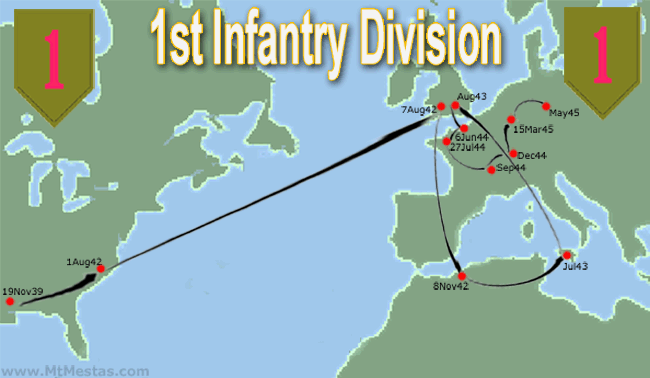
| 1939 |
|
19
Nov- |
The 1st Division
started preparing for World War
II by moving to Fort Benning, Georgia
and ran its personnel through the
Infantry School. |
1940 |
|
11
May- |
The 1st Division
moved to the Sabine Parish, Louisiana
area on to participate in the Louisiana
Maneuvers. |
5
Jun- |
The 1st Division
returned to Fort Hamilton. |
1941 |
|
| 4
Feb- |
The 1st Division
returned to Fort Devens, Massachusetts. |
Oct-
|
The Division was
sent to both Carolina Maneuvres
of October -and
November 1941 then moved to Samarcand,
North Carolina. |
6
Dec- |
The 1st Division
returned to Fort Devens, Massachusetts. |
1942 |
|
21
Feb- |
The 1st Division
transferred to Camp Blanding, Florida. |
15
May- |
The 1st Division
was re-designated 1st Infantry Division. |
22
May- |
The 1st Division
moved then to Fort Benning, Georgia. |
| 21
Jun- |
The 1st Division
moved Indian Town Gap Mil Reservation. |
1
Aug- |
The Division departed
New York Port of Embarkation. |
7
Aug- |
The Division arrived
in England. |
2
Nov- |
The Division left
for North Africa. |
8
Nov- |
The Division landed
in Oran, Algeria on as part of Operation
Torch. |
1943 |
|
21
Jan- |
Elements then took
part in combat at Maktar, Tebourba,
Medjez el Bab, Kasserine Pass, Gafsa,
El Guettar, Béja, and Mateur,
helping secure Tunisia to 9 May. |
Jul-
|
The Division took
part in Operation Husky in Sicily
under the command of Major General
Terry de la Mesa Allen. It was assigned
to the II Corps. It was in Sicily
that the 1st saw heavy action when
making amphibious landings on Gela,
the most fortified German beach
head positions. The 1st thenmoved
up through the center of Sicily,
slogging it out through the mountains
along with the 45th Infantry Division.
In these mountains, the division
saw some of the heaviest fighting
inthe entire Sicilian campaign at
Troina; some units losing more than
half their strength in assaulting
the mountain town. |
7
Aug- |
The Division command
was assumed by Major General Clarence
R. Huebner. When that campaign was
over, the division returned to England
to prepare for the Normandy invasion.
It was one of the two divisions
that stormed Omaha Beach on D-Day,
with some of the division's units
suffering 30 percent casualties
in the first hour of the assault,
and secured Formigny and Caumont
in the beachhead by the end of the
day. |
1944 |
|
27
Jul- |
The Division followed
up the St. Lo break-through with
an attack on Marigny. |
Sep- |
The Division drove
across France in a continuous offensive,
reaching the German border at Aachen
in September. |
21
Oct- |
The Division laid
siege to Aachen, taking the city
after a direct assault. |
7
Dec- |
The Division attacked
east of Aachen through Hurtgen Forest,
driving to the Roer, and moved to
a rest area for its first real rest
in 6 months' combat. |
16
Dec- |
The Wacht Am Rhein
offensive (commonly called the Battle
of the Bulge) suddenly broke loose. |
17
Dec- |
The Division raced
to the Ardennes, fighting continuously
to help blunt and turn back the
German offensive to 28 Jan 45. |
1945 |
|
23
Feb- |
The Division attacked
and again breached the Siegfried
Line, fought across the Roer and
drove on to the Rhine. |
15
Mar- |
The Division crossed
at the Remagen bridgehead. The division
broke out of the bridgehead, took
part in the encirclement of the
Ruhr Pocket, captured Paderborn,
pushed through the Harz Mountaiins,
and was in Czechoslovakia, fighting
at Kinsperk, Sangerberg, and Mnichov
when the war in Europe ended. Sixteen
members of the division were awarded
the Medal of Honor. |
|
|
| |
1st
Infantry
Division
"Big Red One"
"The Fighting First"
|
|
1st Infantry
Division History
The
1st Infantry Division of the United
States Army is the oldest division
in the United States Army. It
has seen continuous service since
its organization in 1917. It was
officially nicknamed the The Big
Red One after its shoulder patch
and is also nicknamed The Fighting
First.
The
1st Division started preparing
for World War II by moving to
Fort Benning, Georgia on November
19, 1939, and ran its personnel
through the Infantry School. It
then moved to the Sabine Parish,
Louisiana area on May 11, 1940
to participate in the Louisiana
Maneuvers. They then returned
to Fort Hamilton on June 5, 1940
then to Fort Devens, Massachusetts
on February 4, 1941.
The
Division was sent to both Carolina
Maneuvres of October and November
1941 then moved to Samarcand,
North Carolina. On December 6,
1941, the 1st Division returned
to Fort Devens, Massachusetts
and was later transferred to Camp
Blanding, Florida on February
21, 1942 where it was re-designated
1st Infantry Division on May 15,
1942.
The
division moved then to Fort Benning,
Georgia on May 22, 1942, and to
Indian Town Gap Military Reservation
on Jun 21, 1942. The Division
departed New York Port of Embarkation
on August 1, 1942, arrived in
England on August 7, 1942.
The
division landed in Oran, Algeria
on November 8, 1942, as part of
Operation Torch, the first time
that America was to campaign against
the Axis powers. The initial lessons
of combat were harsh and many
men were casualties in the campaign
that followed and which stretched
from Algiers into Tunisia, including
the Kasserine Pass.
Elements
took part in combat at Maktar,
Tebourba, Medjez el Bab, Kasserine
Pass, Gafsa, El Guettar, Béja,
and Mateur, from January 21, 1943
to May 9, 1943, helping secure
Tunisia. On May 9, 1943, the commander
of the German "Afrika Korps" surrendered
his force of 40,000 and North
African operations for the Big
Red One ended.
The
Division moved on to help take
Sicily in "Operation Husky." under
the command of Major General Terry
de la Mesa Allen. It was assigned
to the II Corps. It was in Sicily
that the 1st saw heavy action
when making amphibious landings
on Gela, the most fortified German
beach head positions.
It
stormed ashore at Gela, July 10,
1943, and quickly overpowered
the Italian defenses. Soon after,
the Division came face-to-face
with 100 tanks of the Herman Goering
Tank Division. With the help of
naval gunfire, its own artillery
and Canadian allies, the First
Infantry Division fought its way
over the island's hills, driving
the enemy back.
The
division then moved up through
the center of Sicily, slogging
it out through the mountains along
with the 45th Infantry Division.
In these mountains, the division
saw some of the heaviest fighting
in the entire Sicilian campaign
at Troina; some units losing more
than half their strength in assaulting
the mountain town.
The
division advanced on to capture
Troina and opened the Allied road
to the straits of Messina. On
August 7, 1943, command was assumed
by Major General Clarence R. Huebner.
When
that campaign was over, the division
returned to England to prepare
for the Normandy invasion. It
was one of the two divisions that
stormed Omaha Beach on D-Day,
with some of the division's units
suffering 30 percent casualties
in the first hour of the assault,
and secured Formigny and Caumont
in the beachhead by the end of
the day.
On
D-Day the division stormed ashore
at Omaha Beach. Soon after H-Hour,
the Division's 16th Infantry Regiment
was fighting for its life on a
strip of beach near Coleville-sur-Mer
that had been marked the "Easy
Red" on battle maps. As the assault
progressed, the beach became so
congested with destroyed equipment,
the dead and the wounded, that
there was little room to land
reinforcements. Col. George Taylor,
commander of the 16th Infantry
Regt., told his men, "Two kinds
of people are staying on this
beach! The dead and those who
are going to die! Now, let's get
the hell out of here!" Slowly,
spurred by the individual heroism
of many individuals, the move
inland got underway. After the
beachhead was secured, the Division
moved through the Normandy Hedgerows.
The
division followed up the St. Lo
break-through with an attack on
Marigny, July 27, 1944, and then
drove across France in a continuous
offensive, reaching the German
border at Aachen in September.
The
division liberated Liege, Belgium,
and pushed to the German border,
crossing through the fortified
Siegfried line.
The
division attacked the first major
German city, Aachen, and after
many days of bitter house-to house
fighting, the German commander
surrendered the city on Oct. 21,
1944.
The
First then attacked east of Aachen
through Hurtgen Forest, driving
to the Roer, and moved to a rest
area December 7, 1944 for its
first real rest in 6 months' combat,
when the Wacht Am Rhein offensive
(commonly called the Battle of
the Bulge) suddenly broke loose
on December 16, 1944 when 24 enemy
divisions, 10 of which were armored,
launched a massive counterattack
in the Ardennes sector. The division
held the critical shoulder of
the "Bulge" at Bullingen, destroying
hundreds of German tanks in the
process.
On
Jan. 15, 1945, the First Infantry
attacked and penetrated the Siegfried
line for the second time.
Continuously
fighting from December 17, 1944
to January 28, 1945, the division
helped blunt and turn back the
German offensive.
The
division fought across the Roer,
February 23 and drove on to the
Rhine, crossing at the Remagen
bridgehead, March 15–16.
The
division broke out of the bridgehead,
took part in the encirclement
of the Ruhr Pocket, captured Paderborn,
pushed through the Harz Mountaiins.
On
Easter Sunday, April 1, 1945,
the Division marched 150 miles
to the east of Siegen. On April
8, the Division crossed the Weser
River and was in Czechoslovakia,
fighting at Kinsperk, Sangerberg,
and Mnichov when the war in Europe
ended May 8, 1945.
At
the end of World War II, over
100,000 prisoners had been taken,
the Division had suffered 21,023
casualties and 43,743 men had
served in its ranks. Its soldiers
had taken part in 3 amphibious
assaults, won a total of 20,752
medals and awards, earned 7 battle
streamers, a Presidential Unit
Citation, 5 foreign awards and
16 members of the division were
awarded the Medal of Honor.
Beginning
another occupation of Germany,
the 26th Infantry Regiment "Blue
Spaders" were given the honor
of bearing the United States National
Colors at the Allied Victory in
Europe parade, and were selected
to serve as America’s guard
of honor at the Nuremberg War
Crimes Trials. Thus began a lengthy
stay in Germany, first as conquerors
and later as friends and Allies. |
|
|
| |
16th
Infantry
Regiment
"Always
Prepared"
|
|
16th Infantry
Regiment History
The
16th returned to the U.S. after
World War I August 1919 serving
at Fort Jay, Governor’s
Island, New York. In the 20 years
that followed, the regiment remained
at Fort Jay where it became known
as “New York’s Own”
and adopted the popular “Sidewalks
of New York” as its regimental
song. The 16th moved to Fort Benning,
Georgia, from New York on 19 November
1939 joining the rest of the 1st
Inf. Div. at Fort Devens, Massachusetts.
In August 1942,
the 16th Inf. Reg. sailed from
New York City abroad the Queen
Mary for Gourok, Scotland. By
9 August 1942 the regiment had
moved into Tidworth Barracks in
southern England.
The16th Infantry
Regiment's 1,700 soldiers took
part in the landings in North
Africa and were the first American
infantry to land on the beaches
during Operation Torch defeating
Rommel's Afrika Corps, and Sicily
Sicily defeating Hermann Goering's
Panzer Division, and at Normandy
and they participated in Operation
Cobra.
Fox Company,
2nd Battalion of the 16th Infantry
was the first unit in the 1st
Division to take part in an offensive
operation when Fox Company supported
by Charlie Company, 1st Battalion,
and George Company, 3rd Battalion
supported by tanks from 1st Armored
assaulted the Le Senia Airfield
just south of Oran, Algeria.
The 400 Americans
killed 270 French soldiers and
captured 700 of them without loss.
During the Battle of Kasserine
Pass the 16th Infantry counterattacked
a line that had been left open
by retreating units of the 26th
Infantry Regiment.
The 16th Infantry's
combat record in World War II
is exceeded by no other U.S. unit.
It was among the first American
units to engage Hitler’s
“Africa Corps” in
Northern Africa, during Operation
Torch, the first combat operation
of the 16th Infantry in World
War II.
During the bitter
fighting in the Kasserine Pass
the 16th earned its third French
‘Croix de Guerre’
for its role in stopping the German
counterattack which nearly destroyed
the U.S. II Corps. At Matuer,
Tunisia, the 16th again distinguished
itself, earning its first Presidential
Unit Citation.
In the Invasion
of Sicily, the 16th was the first
American unit to land on the beaches
of Sicily near Gela and capture
the city with heavy losses on
the beach.
On 10 July 1943,
during Operation Husky at Gela,
the regiment earned its second
Presidential Unit Citation by
stopping a German Panzer Division
and spearheading a subsequent
assault deep into the Sicilian
heartland.
Following Sicily,
the 16th Infantry took part in
the invasion of Europe when they
landed at Omaha beach.
Prior to departing
for Europe again, the 16th Infantry
Regiment became known as "New
York's Own" as it spent over 20
years at Fort Jay, Governor's
Island, New York training, conducting
ceremonies and other various garrison
activities.
It was on Omaha
Beach that the 2-16th Infantry
earned its nickname "Rangers"
as it secured the 2nd Ranger Battalion's
eastern flank, while the Rangers
assaulted the cliffs of Point
du Hoc. The Germans could not
tell the difference between the
2 units as both were disciplined
in the face of murderous fire
and fought with absolute tenacity.
On Omaha Beach,
Normandy, 6 June 1944, the 16th
earned its third Presidential
Unit Citation during Operation
Overlord. That same day, Technician
Fifth Grade John Pinder and 1stLt.
Jimmie Montieth each earned and
received the Medal of Honor at
Colleville-sur-Mer for their roles
in getting American troops across
the fire swept beaches.
For its exceptional
valor in the Normandy Campaign,
the 16th was awarded its forth
French Croix de Guerre Fourragere,
thus being awarded the French
Medaille Militaire Fourragere,
the highest honor ever bestowed
on a foreign unit by the government
of France.
On July 15, elements
of the 16th Infantry raced north
to rescue units of the 82nd Airborne
Division near Piano Lupo and engaged
the Herman Goring Panzer Division
resulting in heavy German losses.
The regiment then moved north
taking several key cities and
towns before taking part in the
battle of Troina.
Over the course
of the next year, the 16th Infantry
Regiment distinguished itself
in battles throughout France,
Belgium, Germany with the rest
of the 1st Infantry Division and
fought its way across Europe,
ending the war in Czechoslovakia. |
|
|
| |
18th
Infantry
Regiment
"Vanguards"
|
|
18th Infantry
Regiment History
On
7 August 1943, during the invasion
of Sicily, the 18th Infantry Regiment
captured Mount Pellegrino which
overlooked the Troina defenses
allowing accurate direction of
Allied artillery.
The 18th Infantry
Regiment was part of the landing
forces that participated in the
initial onset of Operation Overlord
that stormed Omaha Beach.
The regiment was
scheduled to land at 09:30 on
Easy Red. The first battalion
to land, 2/18, arrived at the
E-1 draw 30 minutes late after
a difficult passage through the
congestion off shore.
Casualties were
light, though despite the existence
of a narrow channel through the
beach obstacles the ramps and
mines there accounted for the
loss 22 LCVP s, 2 LCI(L) s and
4 LCT s. Supported by tank and
subsequent naval fire, the newly
arrived troops took the surrender
of the last strong point defending
the entrance to the E-1 draw at
11:30 .
Although a usable
exit was finally opened, congestion
prevented an early exploitation
inland. The three battalions of
the 115th RCT, scheduled to land
from 10:30 on Dog Red and Easy Green
came in together and on top of the
18th RCT landings at Easy Red. The
confusion prevented the remaining
two battalions of the 18th RCT from
landing until 13:00 and delayed
the move off the beach of all but
2/18, which had exited the beach
further east before noon, until
14:00. Even then, this movement
was hampered by mines and enemy
positions still in action further
up the draw. |
|
|
| |
26th
Infantry
Regiment
"Blue
Spaders"
|
|
26th Infantry
Regiment History
The
Blue Spaders deployed to England
and then North Africa when the
United States entered World War
II. Through four years of war,
campaigns were fought from French
Morocco, Tunisia, and Sicily to
Normandy and Central Europe.
The
26th Infantry led America's first-ever
amphibious assault in North Africa,
fought at the Kasserine Pass,
assaulted Sicily, invaded Normandy,
conquered the first German city
of the war at Aachen, vaulted
the Rhine and attacked all the
way to Czechoslovakia by war's
end. The regiment conducted three
amphibious assaults, and earned
seven battle streamers, a Presidential
Unit Citation, and five foreign
awards.
Beginning
another occupation of Germany,
the Blue Spaders were given the
honor of bearing the United States
National Colors at the Allied
Victory in Europe parade, and
were selected to serve as America's
guard of honor at the Nuremberg
War Crimes Trials. Thus began
a lengthy stay in Germany, first
as conquerors and later as friends
and allies. |
|
|
| |
1st
Infantry
Division
Campaigns
|
|
1st
Infantry Division Campaigns
of World War II
| Algeria-French
Morocco |
8
- 11 Nov 42 |
| Tunisia |
17
Nov 42 - 13 May 43 |
| Sicily |
9
Jul - 17 Aug 43 |
| Normandy |
6
Jun - 24 Jul 44 |
| Northern
France |
25
Jul - 14 Sep 44 |
| Rhineland |
15
Sep 44 - 21 Mar 45 |
| Ardennes-Alsace |
16
Dec 44 - 25 Jan 45 |
| Central
Europe |
22
Mar - 11 May 45 |
Algeria
– French Morocco Campaign
8 November – 11 November
1942
Events bringing
the United States Army to North
Africa had begun more than a year
before the Japanese attacked Pearl
Harbor. For both the Axis and
the Allies, the Mediterranean
Sea area was one of uncertain
priority. On the Axis side, the
location of Italy made obvious
Rome’s interest in the region.
But the stronger German partner
pursued interests hundreds of
miles north. A similar division
of emphasis characterized the
Allies. To the British the Mediterranean
Sea was the vital link between
the home islands and long-held
Asian possessions as well as Middle
Eastern oil fields. To the Americans,
however, the area had never been
one of vital national interest
and was not seen as the best route
to Berlin. But the fall of France
in June 1940 had also brought
a new dimension to the region.
The surrender of Paris left 120,000
French troops in West and North
Africa and much of the French
fleet in Atlantic and Mediterranean
ports. Both the Axis and Allies
saw overseas French forces as
the decisive advantage that would
allow them to achieve their contradictory
objectives in the Mediterranean.
Tunisia
Campaign
17 November 1942 – 13 May
1943
Victory at Casablanca,
Oran, and Algiers gave the United
States Army and its British ally
solid toeholds in the western
Mediterranean Theater of Operations.
But it offered no guarantee of
easy access to Italy or southern
Europe, or even to the eastern
end of the Mediterranean, where
the British desperately needed
assistance to secure Egypt and
strategic resources in the Near
East. The sudden entrance of American
forces during 8–11 November
1942 created an awkward deployment
in which two pairs of opposing
armies fought in North Africa,
one in Tunisia, the other in Libya.
Neither Axis nor Allies found
any satisfaction in the situation;
much fighting remained before
either adversary could consider
North Africa secure.
If American commanders
and troops thought their brief
combat experience in French Morocco
and Algeria in November 1942 was
adequate preparation to face hardened
Axis units in a lengthy campaign,
the fighting in Tunisia brought
about a harsh reappraisal. With
few exceptions, French units in
North Africa had been more intent
on upholding national honor than
inflicting casualties and damage;
those that offered determined
resistance were at a marked disadvantage
in terms of weapons, equipment,
supplies, and numbers. In Tunisia,
however, American soldiers found
themselves faced with well-trained,
battle-tested units skillfully
using the most advanced weapons
and innovative combined arms tactics
repeatedly to frustrate Allied
plans. The result was painful
to Army units involved and a shock
to the American public: five months
of almost continuous setbacks
with commensurably high casualties.
Sicilian
Campaign
9 July – 17 August 1943
On the night of
9–10 July 1943, an Allied
armada of 2,590 vessels launched
one of the largest combined operations
of World War II—the invasion
of Sicily. Over the next thirty-eight
days, half a million Allied soldiers,
sailors, and airmen grappled with
their German and Italian counterparts
for control of this rocky outwork
of Hitler’s “Fortress
Europe.” When the struggle
was over, Sicily became the first
piece of the Axis homeland to
fall to Allied forces during World
War II. More important, it served
as both a base for the invasion
of Italy and as a training ground
for many of the officers and enlisted
men who eleven months later landed
on the beaches of Normandy.
Normandy
Campaign
6 – 24 July 1944
A great invasion
force stood off the Normandy coast
of France as dawn broke on 6 June
1944: 9 battleships, 23 cruisers,
104 destroyers, and 71 large landing
craft of various descriptions
as well as troop transports, mine
sweepers, and merchantmen—in
all, nearly 5,000 ships of every
type, the largest armada ever
assembled. The naval bombardment
that began at 0550 that morning
detonated large minefields along
the shoreline and destroyed a
number of the enemy’s defensive
positions. To one correspondent,
reporting from the deck of the
cruiser HMS Hillary, it sounded
like “the rhythmic beating
of a gigantic drum” all
along the coast. In the hours
following the bombardment, more
than 100,000 fighting men swept
ashore to begin one of the epic
assaults of history, a “mighty
endeavor,” as President
Franklin D. Roosevelt described
it to the American people, “to
preserve. . . our civilization
and to set free a suffering humanity.”
Northern
France Campaign
25 July – 14 September 1944
As July 1944 entered
its final week, Allied forces
in Normandy faced, at least on
the surface, a most discouraging
situation. In the east, near Caen,
the British and Canadians were
making little progress against
fierce German resistance. In the
west, American troops were bogged
down in the Norman hedgerows.
These massive, square walls of
earth, five feet high and topped
by hedges, had been used by local
farmers over the centuries to
divide their fields and protect
their crops and cattle from strong
ocean winds. The Germans had turned
these embankments into fortresses,
canalizing the American advance
into narrow channels, which were
easily covered by antitank weapons
and machine guns. The stubborn
defenders were also aided by some
of the worst weather seen in Normandy
since the turn of the century,
as incessant downpours turned
country lanes into rivers of mud.
By 25 July, the size of the Allied
beachhead had not even come close
to the dimensions that pre–D-day
planners had anticipated, and
the slow progress revived fears
in the Allied camp of a return
to the static warfare of World
War I. Few would have believed
that, in the space of a month
and a half, Allied armies would
stand triumphant at the German
border.
Rhineland
Campaign
15 September 1944 – 21 March
1945
The Rhineland
Campaign, although costly for
the Allies, had clearly been ruinous
for the Germans. The Germans suffered
some 300,000 casualties and lost
vast amounts of irreplaceable
equipment. Hitler, having demanded
the defense of all of the German
homeland, enabled the Allies to
destroy the Wehrmacht in the West
between the Siegfried Line and
the Rhine River. Now, the Third
Reich lay virtually prostrate
before Eisenhower’s massed
armies.
Ardennes
- Alsace Campaign
16 December 1944 – 25 January
1945
In August 1944,
while his armies were being destroyed
in Normandy, Hitler secretly put
in motion actions to build a large
reserve force, forbidding its
use to bolster Germany’s
beleaguered defenses. To provide
the needed manpower, he trimmed
existing military forces and conscripted
youths, the unfit, and old men
previously untouched for military
service during World War II.
In September Hitler
named the port of Antwerp, Belgium,
as the objective. Selecting the
Eifel region as a staging area,
Hitler intended to mass twenty-five
divisions for an attack through
the thinly held Ardennes Forest
area of southern Belgium and Luxembourg.
Once the Meuse River was reached
and crossed, these forces would
swing northwest some 60 miles
to envelop the port of Antwerp.
The maneuver was designed to sever
the already stretched Allied supply
lines in the north and to encircle
and destroy a third of the Allies’
ground forces. If successful,
Hitler believed that the offensive
could smash the Allied coalition,
or at least greatly cripple its
ground combat capabilities, leaving
him free to focus on the Russians
at his back door.
Central
Europe Campaign
22 March – 11 May 1945
By the beginning
of the Central Europe Campaign
of World War II, Allied victory
in Europe was inevitable. Having
gambled his future ability to
defend Germany on the Ardennes
offensive and lost, Hitler had
no real strength left to stop
the powerful Allied armies. Yet
Hitler forced the Allies to fight,
often bitterly, for final victory.
Even when the hopelessness of
the German situation became obvious
to his most loyal subordinates,
Hitler refused to admit defeat.
Only when Soviet artillery was
falling around his Berlin headquarters
bunker did the German Fuehrer
begin to perceive the final outcome
of his megalomaniacal crusade. |
|
|
|
|